*This resource was first published in August 2021 and was updated in January 2026. The blog post below has been updated to highlight the updated product.
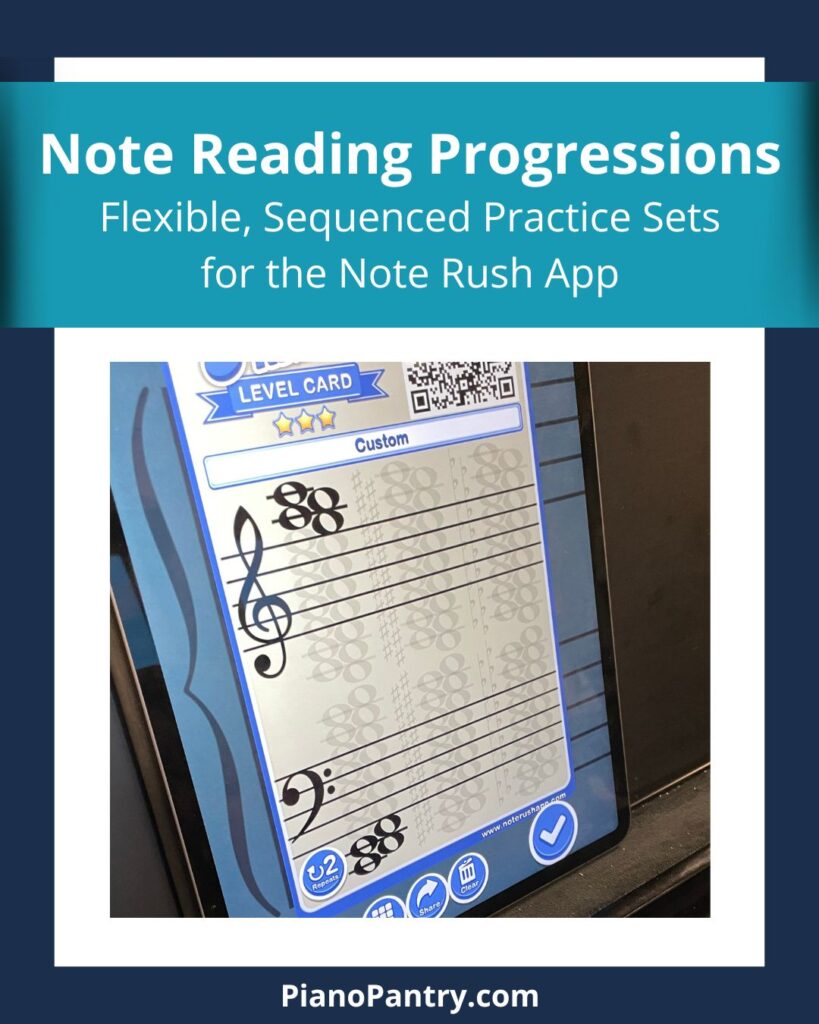
Over the years, I’ve tried many approaches to note-reading: multi-key, intervallic, skips alphabet, landmark, you name it.
No matter which approach I used, I kept running into the same challenge: I needed a clearer way to track where students were in their note-reading journey, and I wanted a progression that helped them avoid feeling overwhelmed by too many notes at once.
(Psst…This newly updated resource also makes it easier to assign note practice at home, complete with hyperlinks, QR codes, and a CSV File!)
I was initially inspired by the One Minute Club, made popular by Jane Bastien and later by Susan Paradis, in which students worked to name and play all of their notes within one minute.
I can’t remember whether Jane’s original version included only the notes on the staff or multiple levels. Either way, I eventually landed on creating my own predetermined progression using the landmark approach, organized into five sequenced sets, and blogged about it in this post.
Set 1 – Bass F through Treble G
Set 2 – Bass C through Treble C
Set 3 – Low F through High G (Grand Staff)
Set 4 – Ledger Lines (C-F in Bass and G-C in Treble)
Set 5 – Grand Staff + Ledgers (Low C to High C including ledgers)
It wasn’t enough, though. I felt like students still need much more focused practice with smaller groups of notes and more repetitions.
Thus was born this series (which has since been expanded even further)!
Even if you don’t use the landmark approach in your teaching, stick with me—this updated resource was designed to support more than just one way of teaching note reading!
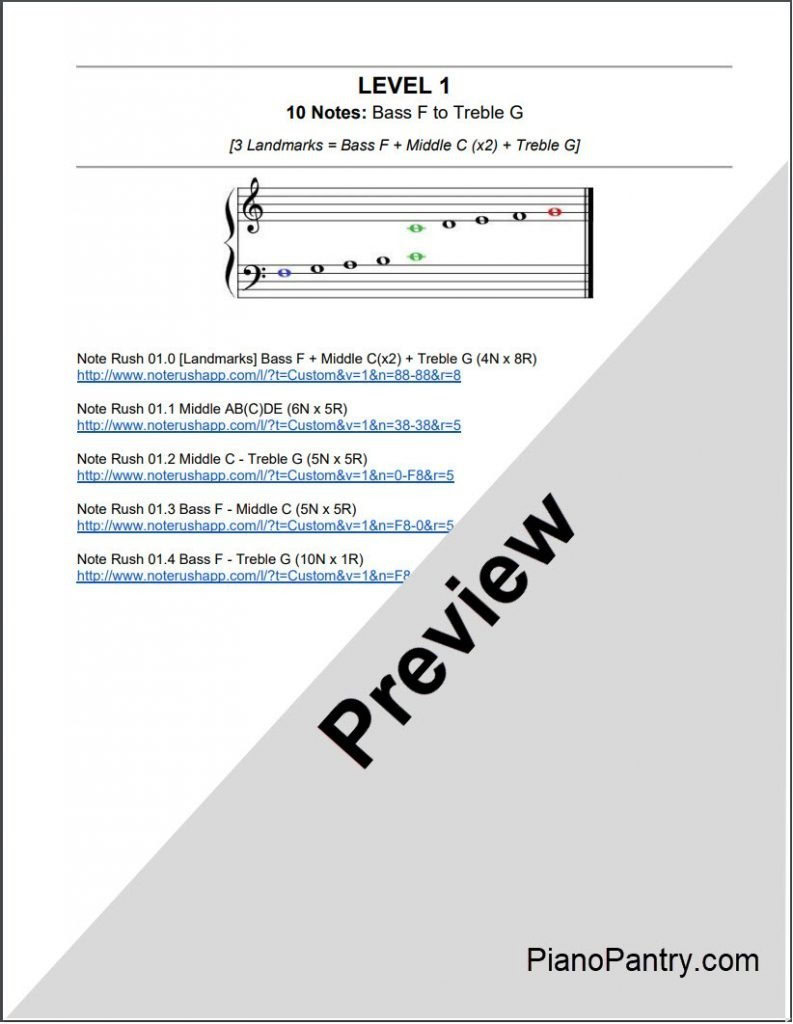
Every set of notes students are working towards is broken down even further into what I call “micro-progressions.” For example, while Set 1 is working toward Bass F through Treble G, students first move through four smaller micro-progressions:
- 01.1 – Landmarks Bass F, C’s, Treble G
- 01.2 – AB(C)DE
- 01.3 – Middle C to Treble C
- 01.4 – Bass F to Middle C … and then finally…
- 01.5 – Bass F to Treble G
Using this numbering system has made it much easier to track which notes students are working on!
From Flashcards to Note Rush
I originally ran my note-naming challenge using flashcards, but as the app Note Rush became more popular, I gradually began using it more and more in my studio.
If you’re not already familiar, Note Rush is an app that supports note reading by displaying notes on the screen and listening for the correct pitch to be played before advancing. Rather than just naming letter names aloud, students demonstrate note recognition by playing the correct key on the piano (or another instrument).

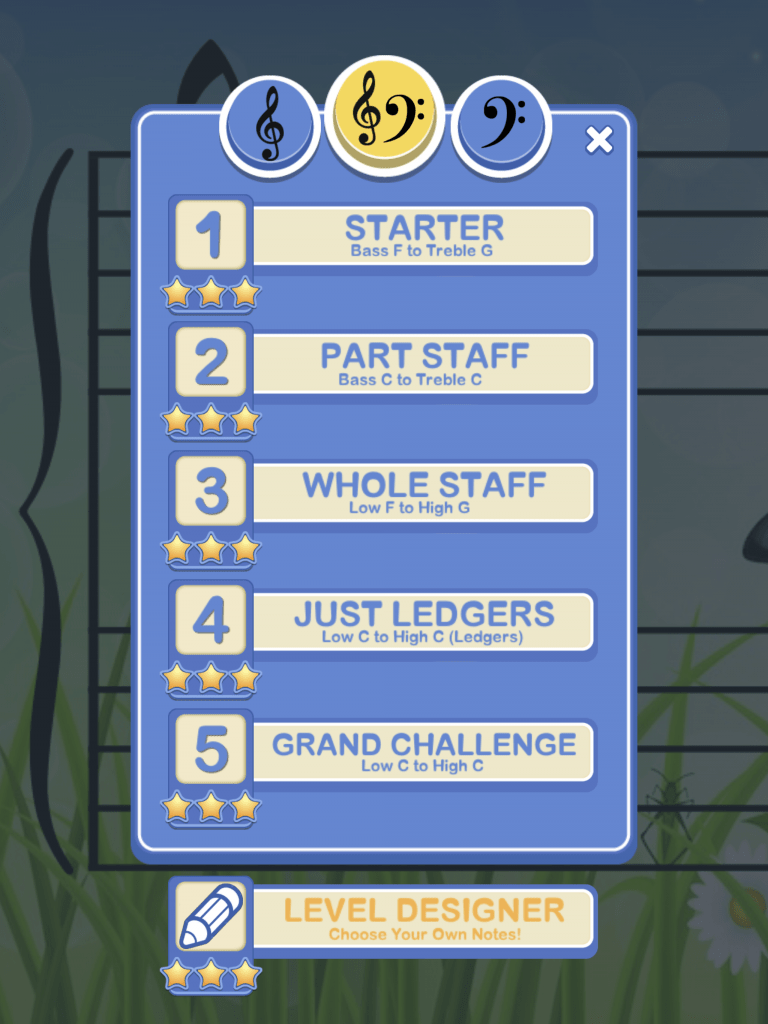
While the app includes an excellent set of five predesigned levels that align well with landmark-based note reading, I found myself frequently using the Level Designer to manually create my micro-progressions.
Note Rush also allows you to create a custom set and share a direct link with a student, so when they click the link, that exact set opens on their device (assuming the app is installed).
So, instead of recreating these micro-progressions again and again, I eventually sat down and designed a complete, well-sequenced collection of sets all at once.
The entire set was in a single document with all hyperlinks included, making it easy to use during lessons.
This is what the original version looked like:
This resource was independently created and is not produced by, affiliated with, or endorsed by Note Rush.
Flexible for In-Studio Use or At-Home Practice
Thanks to changing times and requests over the past few years, this resource has been expanded to be even more accessible to a wider range of note-reading approaches and offers greater flexibility for use, whether during lesson time or when assigning practice at home.
It includes:
- Additional sets (see below)
- QR Codes
- Printable QR Code labels
- CSV File
No matter your approach to teaching note reading—whether landmark-based, skip-alphabet, key sets, or others—you’ll find materials here that support both your teaching and your students’ learning.

This resource contains 11 sequenced note progressions, organized into two categories.
Landmark-Based Progression
- Set 1: Bass F to Treble G
- Set 2: Bass C to Treble C
- Set 3: Grand Staff (Low F to High G)
- Set 4: Ledger Lines
- Set 5: Grand Staff + Ledger Lines
Additional Sets
- Set 6: All Accidentals (Grand Staff)
- Set 7: Piano Safari–Style Note Progressions
- Level 1 Bass C + Treble G, and notes a step or skip up or down + Middle C
- Level 2 Skips Alphabet
- Set 8: Pentascales – F, C, G majors + minors
- Set 9: Pentascales – D, A, E majors + minors
- Set 10: Key Sets – 0 sharps/flats, 1 sharp, 1 flat
- Set 11: ACE Ledger Lines
Accessing The Sets
Inside the file, you will find three different ways to access these 11 practice sets:
- Individual pages for each set (11 pages)
- Printable QR code address labels (11 pages)
- A CSV file (provided via a hyperlink from which you can download the file in CSV format.)
INDIVIDUAL PAGE SETS
Each set has its own dedicated page that displays the group of notes it’s working toward. Hyperlinks and QR codes are included for flexible use. Click a link to open a set on the same device or scan the QR code to open it on a different device.


QR CODE ADDRESS LABELS
To simplify assigning practice at home, a set of QR Code Labels is included and formatted to fit Avery Address Labels 8160. Each label contains both a QR code and a small visual showing the notes in that set. If a student has difficulty scanning the code, they can still easily select the assigned notes by referencing the image.

When designing the QR code labels, I considered which combination sets would be most practical and useful for most teachers — especially when printing a full sheet of labels at a time.
Some pages include multiple sets, while others are dedicated to a single set.
For example, full sheets of Set 1, 3, and 5 are included as these are sets I anticipate teachers using most frequently, whereas sets 2 and 4 are included on a shared page with sets 1-4.
CSV FILE
A CSV file is also available for teachers who use a practice app for assignments. This file contains hyperlinks to every item in each set and can be uploaded into your assignment platform of choice. The numbering system helps keep assignments organized and sequential in a digital format.
You will access the CSV file via a link inside the download.
How To Purchase
We’re all about practical, sustainable resources around here, and I think you will find this one a huge time-saver!
Add this product to your cart or view it in the Piano Pantry shop.
( If you’re interested in creating your own custom sets, here’s a quick video showing what that look slike.)