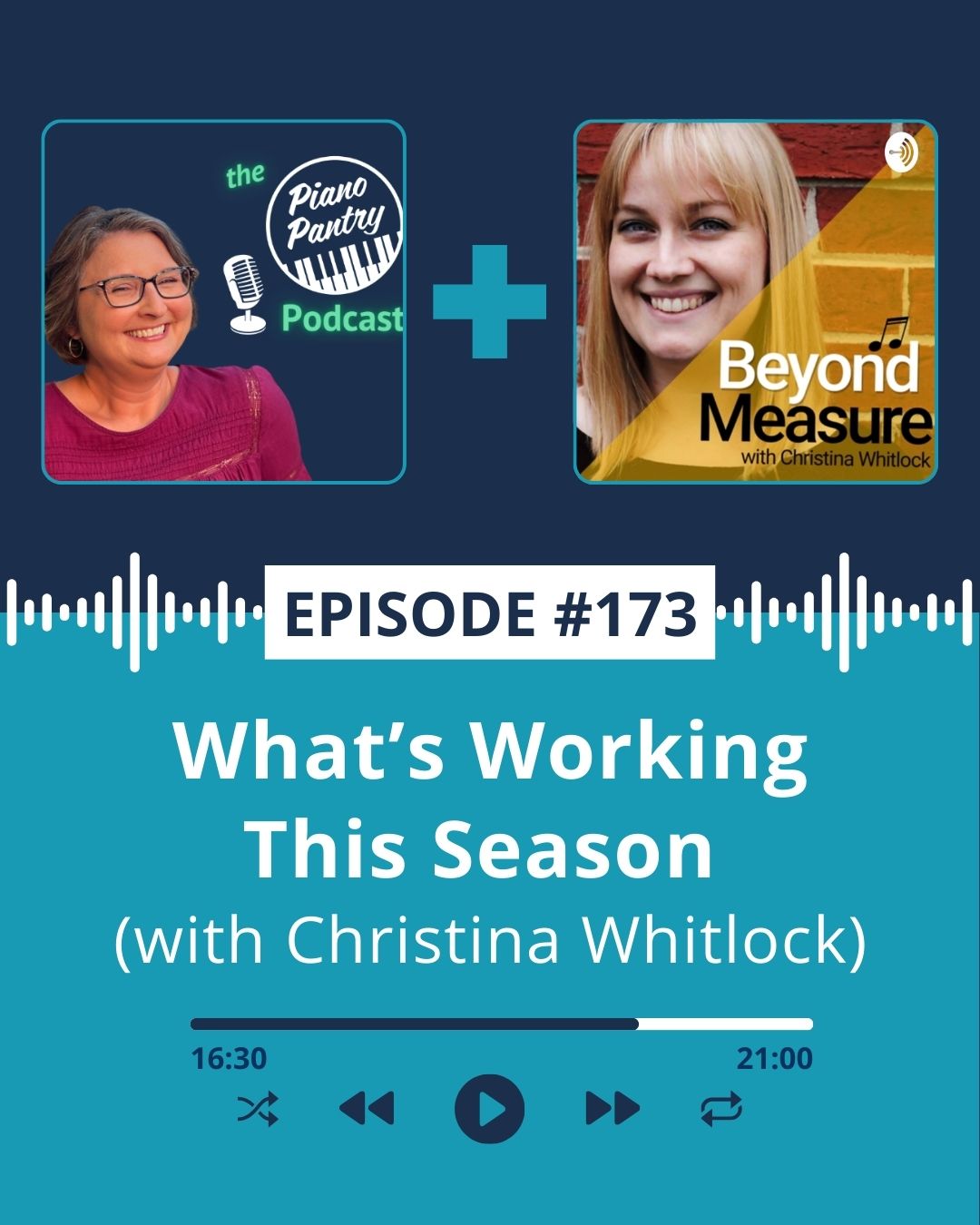
Welcome to episode 173 of The Piano Pantry Podcast. I’m Amy Chaplin your host.
Today, we’re cozying down and getting a little personal as we pause to consider what is working for us in this current season of life. This is the perfect time of year to go through this kind of reflection—not only to help us navigate the busy months ahead, but also to reflect before the new year begins.
It’s such a simple practice with powerful results for our mental health. Plus, it’s just plain fun.
Last December, Christina Whitlock of the Beyond Measure Podcast and I teamed up for a tag-team series of episodes released on our back-to-back publication days, and we decided to keep that tradition going. We kicked things off yesterday over on her podcast, sharing three things each that are not working in our current season. Today, we’re flipping the script to talk about three things that are working for each of us.
I’d say this is the “fun” episode, but truthfully, I think both are equally meaningful. Just because something isn’t working or aligning with you right now doesn’t mean it’s bad—it simply means it’s a moment.
As you listen in, I encourage you to sketch out your own list. I’d love to hear what you come up with! If you follow me on Facebook or Instagram, be sure to share your list in the comments on the podcast post.
Amy: Hey friend. Welcome back to the Piano Pantry podcast. So excited to have you here.
Christina: The Piano Pantry podcast is one of my favorite places to be, so thanks, Amy.
Amy: Aren’t you a great friend. LOL
Here we go. Let’s dive right in. Christina, my friend, since you’re my guest, you get to go first. What is working for you in this season of life?
Christina: I hate to be too repetitive about this because I feel like I’ve been talking about this a lot, but I just have to say what’s working for me in this season of my teaching life is playing with my students more often.
So I have just been finding any excuse to sit down at the digital piano next to my students’ piano and play along with them. And I’ve been doing it more and more, and it’s addictive and it’s just made for a much more inviting and effective lesson experience.
So I sit down at the most basic level and just play like to tonic and dominant chords. Back and forth as they’re playing their pieces and there’s just something so immersive about it.
My students love it because the experience of making music with someone is so powerful—we all know that. But it’s also good for me because it’s like I am actively making music throughout my day. Even when it’s simple stuff – that I just love, and I think it’s been really good for me and my musical spirit, and I will just go on record as saying there’s no better way to correct a student’s tempo than to just sit down and cord next to them and pull them back on. It’s so much more effective than us, like banging our hand against the piano or snapping our fingers or whatever else we do.
Amy: That’s what I was going to. I assume you tend to mostly just make up accompaniment patterns to go along with it. Do you ever actually play along with the piece that they’re playing?
Christina: Yeah, I would say absolutely. I do that for sure too.
And I just wanna say this because I know so many teachers do not feel comfortable just sitting down and playing chords with their students. I 100% did not use to feel comfortable doing that. And the way you get over it is just to do it and to recognize that your students aren’t listening to your chord patterns the way you are.
And if you play the wrong chord at the wrong time, it has a clashing harmony. No one cares. They’re not you.
Amy: And actually, the kids love it because they’re like, “you made a mistake!” Yes and you know what? That’s okay. Even I may hit wrong chords sometimes. LOL
Christina: Absolutely.
I do think that fundamentally, there is something about making music together that is so important, and our students get it in choir and in band.
But they just miss that and the solo lesson experience so much. So when it comes to just their warmups, like I’m consistently playing through when they’re doing scales in arpeggios and chord patterns, I am consistently next to them vamping alongside. And again, as we’re working through repertoire, like there’s no better way to teach a ritardando or an accelerando than just to help guide a student’s pulse.
I know I’ve been guilty of just telling students, “Oh, ritardando means you slow down little by little.” And you explain it, but it’s so much more effective to do it with them and to see how they follow you. And I don’t know, there are a thousand different applications of this, but I will just say finding ways to make music alongside my students is a total win this year.
Amy: Nice. That’s a great one to kick off with.
Christina: Oh, and I just wanna say that if you don’t have a second instrument. That’s okay because you can sit down beside your student and play also, like you do not need two instruments to do that.
How about you, Amy?
Amy: The first one that is working for me in this season is to actually give myself some grace when I can’t physically take care of my body, as in, like working out.
And I’ve gone through seasons where I just beat myself up or oh, I should, I’m not walking every day, or I’m not moving enough, or whatever. And I’ve realized that I just need to feel good about it when I can do it.
There have been pockets of times where I’ll go for weeks or even a couple of months and I’m walking every day for 30 minutes or an hour or doing a workout or Pilates or doing something every day and moving, and then there’s seasons where I just hit a wall where I just can’t, there’s just too much going on in life, and I used to beat myself up more about it, and I’ve just realized this is about what life is.
It’s healthier for me mentally to just do what I can when I can and feel good about it and feel okay about it when I can’t as well.
Christina: I think that is a really good mindset. There are so many things that we feel like are all or nothing – like I am a person who walks every day, or I am a person who doesn’t walk every day. And the truth is that life is that there are going to be times when you can and times when you can’t.
And as long as you’re doing what you have the capacity to do, why would we expect anything else out of ourselves?
But that’s a tough one. I know I’m right there in that struggle boat with you.
Amy: I even actually found that I feel like my body responds to that. So when I don’t have the capacity for it, my body feels okay with it. But when I do, it’s like it craves it. Because it knows that it has that bandwidth to do it. So, anyway, I might be imagining that but…
Christina: No, I think you’re onto something.
It’s like that whole movement of like Intuitive Eating, where if you really just listen to your body, if you train yourself to listen to what it is that your body really is craving, then you know it’s usually beneficial just to give it to your body. And I think exercise is the same way.
I had a day the other day where I was…I thought I was too busy to go for a walk, and my body, like, literally, I just felt this incredibly urgent need to just get outside and get some fresh air and get some movement. And I was like, I’m going to honor that.
So I left whatever I was supposed to do, and I went for a nice long walk, and then I came back and life was great. And it’s helpful.
Amy: I’ve gotten a standing desk here in the last six months, so on days that I can’t, I at least feel like I’m moving a bit, right? More moving around my studio more and sometimes just up and down, like I’m tired of standing. My body also gets tired of standing, and sometimes it just needs to sit. So just be more in tune with that.
All right. Give us your number two!
Christina: Okay. The second thing that is working for me (I’ll do a life thing-I’ll be that girl)…therapy is working for this girl right here. After talking about the benefits of therapy forever, I have actually never done it myself until this fall.
And it’s hard, and it’s uncomfortable sometimes, but I just had a session this morning and I am figuring out all kinds of things about myself, and I think I always struggle because like I didn’t have any significant trauma in childhood. Nothing huge happened to me that scarred me for life.
But we all carry around things, and we all act in certain ways that we don’t want to because of certain things. And I’ve been unpacking all kinds of things about my family of origin, not because they’re terrible people or did awful things, but just because we’re humans and we impact each other in ways that we don’t realize. And it’s been really informative.
I also feel like I’m a walking open wound right now because I just have all these feelings at the surface, but part of the process…I know I asked my counselor today, I was like, “I don’t know what to do! After therapy, like I’m feeling all these things, and I’m like, what do I do with that?!”
And she was like, “You feel them! That’s the point!” LOL
Amy: It doesn’t have to be complicated, Christina.
Christina: Yeah. I was like, “But I don’t want to feel these things!” (which is why I am in therapy, but anyway… LOL). I am learning a lot of things about myself, and I think I’m coming out for the better. Alright, here we go.
Amy: I’m onto number two. This one’s kind of a fun one.
What is working for me now is Trader Joe’s pre-made meals.
Believe it or not, the girl who loves to cook doesn’t always cook. And we have gotten to the point where now that we have quality foods that we can get like pre-made things…back in the day, there wasn’t a lot of good stuff available and now that there are more options.
We much prefer eating a freezer meal from Trader Joe’s than going to fast food for something quick. Anytime I go there, I just grab a small handful of things to just have on hand, whether it’s frozen stuff or refrigerated stuff, and it’s just a lifesaver when you don’t feel like cooking, or you’re just too busy.
A few things, and I’m sure everybody loves hearing these things if you’re a Trader Joe’s person… So some wins recently include their Butternut Squash Risotto, Thai Style Red Curry Soup, and actually that I mixed together with their individual microwavable rice portions. You just put like a bag of rice in the microwave for three minutes, and it’s perfect for just the two of us.
Drew loves tamales, and I tried those for the first time, and he really enjoyed them.
So there are a few fun Trader Joe’s pre-made meal recommendations.
Christina: That sounds excellent. I’m all about it.
I hit a point a few years ago where I was like, easy dinner is the way to go. Like we eat eggs and toast and bacon probably once a week because it’s a meal everybody likes in my house and it’s quick and easy.
Amy: I remember you talking about that on one of your podcast episodes – what’s working for me was quick meals or something like that. I can’t remember exactly how you worded it.
Christina: It was the original – like the first episode I ever did in this series of what’s working for me and what I said was “dinner does not need to be a production.”
Amy: That’s right. Yes. I love it.
Christina: Very life-changing. I ran into somebody once, though, and they said. “Hey, I heard you say on your podcast that you don’t cook dinner anymore. How’s that going?” And I was like, “Where did you get that from? No, I still make dinner.” LOL
Amy: That’s funny.
Christina: Okay, you wanna hear my third thing of the what’s working?
I know you can appreciate this one because you’re my cheerleader, but I significantly downsized my studio numbers this year. And I said in the fall that it was a combo. It’s what’s working and not working. But I think now that we’re heading into December, it’s definitely firmly in the what’s working for me list.
Amy: Yay. For you!
Christina: I know, and I did something (and this is, I know, controversial among us piano teachers). Since I do have a large contingency of homeschoolers and adult students during the day, I have a couple of nights where my evening hours are more open and I have a ton of kids that are in sports and whose schedules are always changing – all the things like we all do.
And I’ve been like open and able to be a little bit more flexible with them. Now my students know it’s always a courtesy. I do not guarantee makeups EVER. But I have been able to play some flip-flop in ways that don’t make me feel like I’m sacrificing my life.
And having that flexibility to do that just feels like a win-win. I think a lot of us come to that no makeup policy because we are just filling every ounce of our time and we have no leeway to work anybody in without it being a huge sacrifice. And I think it’s just one more point in the column to not have the largest studio you can possibly handle.
Amy: I think it’s all context. I think I’ve said this before on my podcast even.
How you handle a lot of your policies has to do with the size of your studio. There’s a lot of things to factor in it. It’s not always black and white or cut and dry.
When I had a lot more students. Yeah. Having that no makeup policy and enforcing it is a lot more important to protect your life.
But as I’ve cut back over the last few years, the smaller my studio gets, the more that I want I’m happy to if I can. And again, the same thing. I never guarantee it. I just say, if you can’t come, there’s no guaranteed makeup. I’ll offer a time if I have it available. If not, I’ll see you next week. And that’s just how it goes.
It’s all about scalability, right?
Christina: Absolutely, and I’ve been putting together the December family calendar here, I’ve been looking at how many different holiday programs and things are creeping up in my schedule, and now I have places to move students and it’s amazing. Like I am just I don’t know, I’m in awe of how this actually works.
And I should say I’m down to 34 students, so it’s not like I’ve gone tiny.
Amy: As my studio has gotten a smaller number-wise, intentionally, that’s been my choice, but my time hasn’t always been less because I’ve had students increasing in their time because I don’t lose students. They stick with me for years, which is a good problem, but I’ve got a lot of students now in 50-minute lessons, 60-minute lessons. I’m like half and half. I think half my students are 40 minutes, the rest are 50 and 60. So it’s still like having 22 students, even though I’ve got like 15.
Christina: Good!
We’ll wrap us up, Amy. What’s the last on your list today?
Amy: The last thing that’s working for me in this season is doing my podcast twice a month. This is something I started at the beginning of 2025. It was both a hard and easy decision at the same time.
Hard because in podcast world, you know that the less you publish, the less listens you get. It’s just a part of the mix and it’s hard to let go of those numbers and oh, seeing all that confirmation, but I, after four years, had to do what was right for me mentally and just having that right place in my life to allow for other things that I was just dying to do and wanting to produce.
So I went down to twice a month, and it’s basically every other week. In my head, I just say twice a month because sometimes I have to skip a week and spread them out however it works best. But that’s been really important for me.
And I’ll admit, I’ve toyed with going back to once a week because there’s a part of me that does miss it sometimes, but I just tell myself, nope, you just gotta do what you can manage and make more long-term to keep it going.
So that was a simple one, but that’s what it is.
Christina: It’s actually really fun to hear a year later because it was a big decision. I know from being your like behind-the-scenes friend that it was hard. And you’ve made me question my weekly podcasts like a million times because (and I predicted this), what’s great about your show going to less frequent is when I see it pop up in my podcast feed, I get really excited and I’m like, “Ooh, Piano Pantry, yeah!” And I don’t know how many people are that excited to see my face on Monday mornings, because it’s just always there. LOL
Amy: I think everybody’s excited to see you. Christina. You’re a bright light. LOL
Christina: I try, but I don’t know…. LOL
Amy: I know exactly what you mean. I’m like that with a lot of podcasts.
After a while, even if they’re a great podcast, I just kind of get burnt out on listening.
It’s part of the cycle and sometimes I’ll go away for a little bit and then come back again (especially the ones that even publish once a month). I’m like, “Ooh, ooh, a new one’s published!”
So I don’t think it’s a bad thing for me.
Christina: The weekly thing I’ve learned, because I’ve actually skipped a few weeks here and there this fall, because life was overwhelming and I decided it wasn’t worth pushing it.
But there is something about the weekly rhythm that – for me – I really need, otherwise it becomes harder. So that’s why I’ve stuck with every week, but I’ve been eyeballing you in this smaller production schedule.
Amy: I don’t think you’re wrong there. There is some truth to the fact that when I don’t publish every week, it feels a little bit harder to get into that mental space when I do go to publish. There’s definitely something to that as well.
Christina: And I think the thing we’re all so stuck on – looking at things as like today and right now. But the truth of the matter is, you and I will not podcast forever! Like this thing will come to an end eventually or trickle down to even less frequent. That’s just the way these things are, but they feel like such institutions to us. Because they take up so much of our brain space.
Amy: I’m okay with my decision! LOL
Christina, this is so much fun. I just love getting on here with you and sharing these little life things because that’s what we’re all about around here.
Feeling different rhythms for our life that are sustainable – especially sustainable – because that’s so important. And this last one, I think leaves us right on that note.
So thank you so much for being here, and I’m sure we’ll do this again!
Christina: Oh, I can’t wait!
If you’re enjoying all the work happening over on Piano Pantry, whether it’s these podcasts or other free content on the blog like Friday Finds, the new recipe posts, and more, I invite you to join me on Patreon, where friends of Piano Pantry team up together for as little as $4 a month to keep this content going ad-free.
It’s a simple concept: join at the silent partner level, or get a few small kickbacks from me as a thank-you for a few dollars more.
In this season of Thanks and giving, I’m feeling incredibly grateful for those who have taken the time to pitch in in this small but effective way.
Visit PianoPantry.com/patreon to join today.
Also, just a quick note to remind you that all items in the Piano Pantry shop are on sale 25% off through Friday, December 5, 2025, including my recently released updates of Christmas By Ear and the Christmas Music Listening Guide. Use code BF2025 at checkout. That’s code BF2025 to get 25% off anything at PianoPantry.com/shop