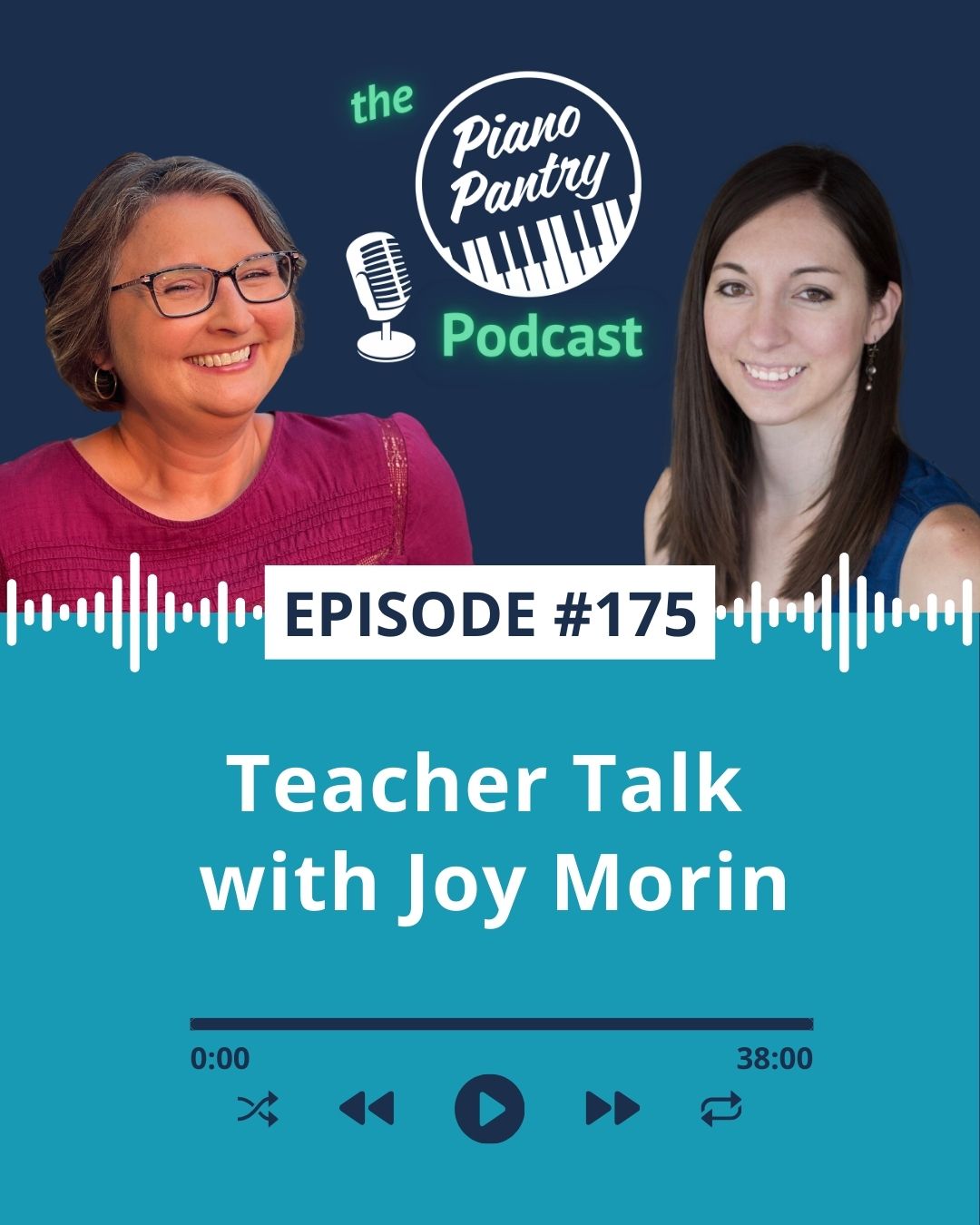
You’re listening to the Piano Pantry Podcast, a place where you will find practical and sustainable rhythms for your studio music teacher life. I’m Amy Chaplin, a piano teacher from Indiana, host of this podcast, and creator of the blog at PianoPantry.com.
Today you’re going to hear from Joy Morin, a piano teacher from Ohio who has been an amazing support system for this profession for more than 15 years, ever since she started sharing resources and insights on her website ColorinMyPiano.com.
As one of my closest teacher friends, I’m so happy to have her help me kick off year number 5 of this podcast, which started in January of 2022. If you’ve been around here since day one – can you believe it?! I sure can’t. If you’re new around here, welcome!
The first three years of this podcast were weekly, but the realities of life led me to stretch it out to a twice-a-month podcast.
Most episodes are 8-12 minute solo episodes, and every 5 episodes I chat with another teacher, as we’re doing today. I like to keep things as short and sweet as possible, so let’s dive in.
Amy:
Welcome to the Piano Pantry podcast. Joy, it’s not your first time here. This is, I think, your fourth time. We were just chatting before we started recording. So you were on the very first, not the first, teacher talk, but the first group teacher talk, and then we chatted once about ways we used Notion, and then we did a wrap-up this past.
July from NCKP, which was actually a really popular one. So it’s easy to think that everybody knows you because you’ve been here a little bit, and we’ve known each other for a long time. But I know that’s not the case. So why don’t you just go ahead and give us a little quick introduction?
Joy:
I’m Joy Morin. I live in Michigan, in the Ann Arbor area, in a town just outside of Ann Arbor called Saline. And I live here with my husband, and I have two kids. They are ages five and three. Yes, I’m a piano teacher, of course, and have been doing that for just over 20 years now. I teach about 20 to 25 students each week, and they come to my home.
I generally teach Monday through Thursday. I consider that my main focus, my first love as far as working goes, is my teaching. But I wear other hats too. I currently serve as the director of music at a small church that is practically next door. This was an unexpected position to get three years ago.
I guess it fell in my lap when the pastor reached out and found me, as I think on the Google map that I was really nearby, really close by to the church, and wondered if I could be the interim pianist for a summer while they did. Search. And then I ended up really enjoying playing for this church and found the sense of community and all the local ministries they run in our town.
Just so impressive for such a little church. And so I put my resume in the pile too and then got the position. So anyway, that’s been a really rewarding kind of side gig along with my teaching, and I’m finding that it complements my teaching schedule and my family schedule, with having two little kids now that I wanna be able to spend time with in the evenings.
So that’s one of my hats these days is working at the church. And that’s a position that is 10 hours a week, and I play for the Sunday service, select hymns, direct the choir, and arrange for guest musicians. We’re doing a sound-and-silence series. There’s a lot going on there in that position.
So other than that, I like to be active in my local music teacher organizations, in my local chapters as well as at the state level and at the national level. I’m currently on a position for the Francis Clark Center and also just recently became Secretary for the Gordon Institute for Music Learning, which is really exciting.
I’m passionate about the work of all of those organizations and consider it a great honor to be involved with that sort of volunteer work as well. So that covers a variety of the hats that I wear right now and what life looks like. It’s busy and full, but I wouldn’t want it any other way.
Amy:
And you’ve had a lot of hats over the years, a lot of different organizations that you’ve been a part of, and both of us have.
The more that you teach, the longer you do that you shift in and out of seasons with different things that you do. But it’s hard to believe. We’ve been teaching for 20 years. Can you believe it? It sounds like such a big number. It’s,
Joy:
Sometimes my husband and I look at each other like, when did we start getting old?
We’re not that old yet. You start to just realize you’ve been doing things for a while.
Amy:
You and I have known each other for quite a while now. At this point, I don’t have the exact dates in my mind, but I know that we’ve at least known of each other, I would say, since around 2010, maybe.
When I was in grad school, I was aware of you as a blogger, and we eventually found out we had a mutual friend I went to undergrad with, and you went to grad school with. I just started following you online. And we were roommates for NCKP, I think in 2015. I was looking for a roommate, and you offered for me to stay with you and a friend of yours, and from there, it just blossomed.
So we’ve been good friends now, I would say for a good 10 years and even traveled to Boston to our MLT training in 2016, I think together, and spent two weeks together studying and, sleeping in the same apartment and talking all things MLT at that time. So does that sound all about right?
Joy:
That sounds about right. That covers it I think one of my favorite things is just whenever there’s a conference coming up, being able to check in with you and say, Amy, will you be my roommate for this conference? Yeah. It’s always such a treat to get, to spend that more extended time together for a few days.
Amy:
I think teachers, the more that you’re. Involved in getting to know other teachers in the community. You do eventually find that one person that you end up budding with as much as you can anytime you go to a conference as a go-to person. So that’s fun to have. Why don’t you go ahead and spend a moment just giving us a look at your studio over the past 20 years.
I love hearing how studios evolve and change and grow and I would just like to hear a little bit about what your landscape of your studio has looked like.
Joy:
Sure, I’ll start at the beginning here. So I started teaching piano as a senior in high school. And that was, around the time obviously, that I was about to start my program as a music major for undergrad.
And so as I was figuring things out about my own future and what I wanted to do, that was the year I started teaching and at the start it was that I was teaching my then boyfriend’s two SI sisters. So they were my first piano students. And then soon after, my parents decided that I could teach my own siblings.
So I taught my two younger siblings. They were my next two students on my roster. And then it grew from there. I think it grew mostly it was, some of the kids at the church, my that I grew up in with my family. And yeah, it was basically one of my jobs during college to put myself through college.
And I was teaching out of my parents’ home. That was my start, and I took it very seriously, even from the beginning that this is what I was doing. And it was, very important to me. It was the entire reason why I was in music school was because I wanted to be a piano teacher and I wanted to work on my skills as a pianist, and I wanted to learn how to teach better.
And that was my start. And so I think I had maybe between 10 and 15 students throughout undergrad. I met my husband at undergrad and we got married and then we both decided to apply to graduate school programs. And so we moved. And so that meant I had to say goodbye to my piano students, and this was in west Michigan where I grew up.
And we moved to Central Michigan to attend grad school. So we were there for two years and graduate school was fairly intense. And so I didn’t teach as many students during those two years, but I, it was important to me to at least have a few. So I think I had between three and five students throughout those two years at grad school and they had a community music school program, there at the university that I was able to teach through.
So once we graduated from there at Central Michigan University, then we moved to Ohio. My husband wanted to do another grad program, and so he applied at Bowling Green State University and got into, to the program there. He has degrees in creative writing and so we. Moved to Bowling Green, Ohio and settled there and I started my piano studio fresh again.
So this is a, bowling Green is a small college town in Ohio and I, all of my marketing skills to work, I wanted to know a little bit more about the business side of teaching. I felt like my pedagogy, classes that I had. Taken in undergrad and grad school had served me well for preparing me to teach, but I didn’t feel like I really understood the business side.
Things like taxes and the legal issues and how to set things up. So I went to the library, checked out a stack of books on the topic, and read them that summer after grad school. I love that. Yeah. To the library. I, yeah, I know, right? Isn’t it? It’s funny now because now you would just go online and maybe take a course or something like that, or ask Chat GPT—talk to AI. But yeah, I checked out a whole stack of books and read that stack of books that summer and found out what I needed to know and got connected with a CPA and learned about the zoning laws in my local town, and all those kinds of things, and got that side of things figured out.
And most of my students that I was getting of course, were beginners. And I think that’s generally true when you move to a new area, then you’re building your own studio from the ground up. And so I had, many beginners and elementary students, for a number of years there. And, gradually they got older, and I took some transfer students, so I had some variety in the ages.
I had some adult students as well. And then I think my studio grew very slowly. I felt like I was doing everything I could in terms of marketing that I could think of. But still, I think it just I learned at the time as well as since then that I think even when you do everything right marketing wise, there is still always that factor of whatever the demand is for lessons in your local area.
And so that was an interesting lesson for me to learn. And I remember so clearly my husband and I had no money coming out of grad school, and he was still in grad school. Cool. And so I was the breadwinner, and I really felt the pressure of wanting to have an income that we could live and support ourselves on.
And so I had done the math to figure out what was my number of students I needed to hit so that we could break even and stop living on our savings. And then I had done the math to figure out what number of students would allow us to like, be able to breathe a little and to start replacing our emergency savings fund and that sort of thing.
And actually have a little breathing room anyway. And it, for me, it took too long. It felt too long, but it all worked out in the end. I eventually did fill up my studio, and I didn’t really know exactly how many students I wanted to build up to, so I just kept taking.
Students, as my schedule allowed, until I hit 35. When I hit 35 students, I felt this is enough. This is as busy as I want to be in the after-school hours. I’m like a morning person. I don’t really like to teach past, like seven o’clock is my hard stop limit. I don’t want to teach past 7 o’clock if I can help it.
And I can do that a night or two a week, but I would rather be finished with my teaching day at six or six 30. That’s just how my energy is and whatever. That’s just my preference. And so anyway, when I hit 35, I said, okay, that’s enough. And then I didn’t accept more students and then let that slowly fall back.
And I felt more comfortable with 30 now with kids that I wanna be able to see my own two kids in the evenings. I’m more comfortable with the 20 to 25 for now, but maybe. Maybe once they’re older and out of the house, then I’ll probably go back to 30 and who knows? But that’s one of the beauties of being a piano teacher, of course, is the flexibility that we can.
Manage our teaching load to whatever number we’d like to, so
Amy:
That same thing happened with me too. Like, I pushed myself more and more until you just hit that max where you’re like, whoa, okay. That, yes, that’s it. Yep. I think at one point I got to 45, but I was also doing a few group classes, like adult classes and beginner classes as well, but then the same thing.
Pulled it back. Pulled it back. Pulled it back,
Joy:
Yes, and you don’t know it until you’re there, so you just do it. Part of the learning experience. So anyway so my husband and I lived in Ohio for eight years. And then we were ready to start having kids and we had always planned to move back to Michigan ’cause both he and I are from Michigan originally.
And as we were thinking about and getting ready to have kids, we started looking for houses to buy back home in Michigan. And we wanted to move to the Ann Arbor area because that’s where he’s originally from. And I really love Ann Arbor, and anyway, we found a house, bought the house, and moved in December, and I was very pregnant with my older daughter at the time.
We moved and got settled. I let my Ohio students know that I was moving away, but that I could continue teaching them. And what I actually ended up doing, my plan was, so it’s actually only an hour’s drive from where we were living in northwest Ohio to where we live now in. Southeast Michigan, it’s only an hour’s drive, and my husband was actually commuting.
He had a job at this point at University of Michigan. And he was commuting an hour every day to get to work and to come back again. And so I said, I thought to myself I can do that commute too. I can come down and teach at least one day of my piano students in Ohio, so I don’t have to say goodbye to everybody.
And so that’s what I did. I found a studio space in Ohio where I could teach for one day a week, and I was gonna just have this massive teaching day with whatever students wanted to continue with me. At this new location in Ohio. And so I had that all hooked up and planned up and I followed through on that plan for the month of January, still very pregnant.
And I had this Tuesday, where I came down and taught a full day, and then drove back home, and then my daughter came on her due date on February two. And
Amy:
We all know what’s coming, right? Yeah. We all know what’s coming.
Joy:
The year was 2020. There you go. So what thing happened in 2020?
Let me think. So anyway, I had, my daughter, went on maternity leave six weeks later was when all the lockdown started happening for the pandemic in Michigan. And so I, I couldn’t return back to my teaching in Ohio like I had planned, and I never ended up going back. We ended up.
Going online with everyone. And so I never ended up needing to rent that space again after that. So we all know how the pandemic was, what that was like. But anyway, to fast forward to today. I’ve continued teaching those Ohio students until they’ve just naturally graduated or chosen to discontinue lessons or whatever.
And so I’m currently down to just, I think four of them that I still teach online, which is really fun. It’s really been made it possible for me to teach some of my longtime students even longer, which has just been so much fun. So that’s been great. And then I’ve just been gradually adding Michigan students as my schedule allows.
Since then, as I mentioned before, I’m at 20 to 25 students now, and I do have a lot of beginners and elementary students in my studio. Again, because of moving to a new area. And those are the students who have. Come to me. But I have also picked up a few high school students as transfer students, which has been nice to have that variety, because I think the beginners in elementary ages are actually my favorites to teach.
And so I love having a studio full of that age. But I do like the variety of having at least a few students who are intermediate or getting towards advanced or advanced. So that’s the current makeup of my students right now.
Amy:
I find it interesting because I’m in a season myself right now where I almost have hardly any beginner students, and it’s been like that for a few years, where I think I’ve just been teaching in this area and I didn’t move.
Like you went through where your studio transitions and you start over again. And so I’ve really just been the same place for now 15 years and it’s interesting how you see that change in the landscape of your students. And I’ve had intermediate level students as probably two-thirds of my student roster for several years now.
So it’s just interesting. I’m just waiting for that day when they all become elementary again.
And some of it is as I’m downsizing my studio a little bit more each year here and there, you don’t take on as many students, so you just have your current students. We know you have lots more going on besides your teaching.
You shared a little bit about the beginning, especially if someone is new around here and doesn’t know what you do in your color in my piano blog.
Could you just share a bit about what your blog offers?
Joy:
Sure, yes. I’ve been blogging since 2009, which was when I was in grad school when I first started it.
And at this point, there’s quite a large archive of blog posts on a wide variety of topics. So there’s lots to explore. I consider my blog to be basically a journal of my own piano teaching experiences, and I just write articles about whatever strikes my fancy, to be honest. And that’s the way I like it, that I can just.
Write about whatever I’m exploring in my teaching or whatever it is that I’m thinking about. So lots of different topics addressed on the blog. There’s also a variety of printables that you can download for free. Worksheets, games, lesson plans, that sort of thing. And there’s also a shop where I sell digital resources that are a little bit larger products, I guess, than the single sheet printables in my shop.
You could find things like some of my original compositions. There’s also some camp curriculums. In the past, I’ve done a lot with summer camps with my students and have found that to be very fun and rewarding, and some music history, resources as well.
Amy:
She most recently posted the biggest blog post ever with the ultimate list of recital themes.
I was seriously impressed. That had to have been so much work. And I know that you had some teacher friends help you, but this was like the ultimate recital theme list guide with. Supporting songs and everything, and I actually use it as my starting point, as it says, planning my spring recital because we’re gonna do a wild West theme, and it’s the first time I’ve ever done an actual theme recital for my spring recital.
We’ve done a few in the past for fall time. Like I did a color recital once and that, but it’s been a while, and so it was fun to have a starting point, at least of a few things to get you going, and just keywords and things like that to be thinking about. So definitely check that out.
Teachers, it’s a pretty impressive.
Joy:
That was the kind of project that I just love to do, which is just like to sit and brainstorm, and then just to be thinking about what teaching pieces are out there that would fit the themes. And so it, it definitely took a lot of time to put that post together and compile all those ideas, and then to do all the links and talk about, write all the books and composers Yeah.
Related to the themes. But it was super fun to do.
Amy:
So share with us a little bit about what is capturing your attention as a teacher these days? What’s intriguing to you?
Joy:
You had mentioned earlier music learning theory and that being the work of Edwin Gordon. So that was an approach that Amy and I both did, did some training starting in 2016.
And that has really captured my attention ever since. And that is still very much my. Passion and what I’m working to incorporate into my teaching practice, and so it’s something I spend a lot of time thinking about. I really think that there’s a lot of value in. Gordon’s work that we can bring into piano teaching and it really is very uncharted territory as far as I’m concerned.
Gordon’s work was just so rich. All the research that he did, all the thinking and writing that he did on music teaching and how we wanna be teaching the inner musician, and basically our ear, or as he liked to call it, our ideation. And having that be the basis of music education. And then there’s also our outer instrument, being the piano or whatever it might be.
For Gordon, he was talking and thinking mostly about public education in the schools, and how music is taught in that kind of situation. But that’s where there have certainly been some key figures that have started thinking about how do we take Gordon’s work and his research, if he’s right, if he’s on the right track with what he was thinking about music education and what he thought was important and what can we do to increase the quality of music education?
Then what does that mean for us as piano teachers? That’s such an important question. I think. And a really worthwhile question. So that’s definitely something that has still captured my attention to this day and something I spend a lot of time thinking about and experimenting with my students.
And I don’t feel that I have all the answers. I feel very far from the answers still on most days, but that’s part of the joy of it, I think, is being on this journey to try to. Figure out how to improve my own teaching, for the sake of my students. So I enjoy reading Gordon’s books, his writings, listening to lectures or whatever, off and on come back to that.
And in the past year, I’ve gotten to know a practitioner of Gordon’s work by the name of Mary Ellen Pino. And have really, the two of us have hit it off and become friends. And I’ve learned a lot from her book. She’s written two books now. One of them was just recently released, and she, although teaching the piano, was not her main instrument.
She has a lot to offer, and I think she would work well in our environment as a piano teacher. And so that has also given me a lot of great food for thought and things to try in my own teaching right now, which has been a lot of fun.
Amy:
So along those same lines, what is something that has been working for you in this season of your teaching and in your studio?
Joy:
You actually mentioned it earlier with my blog post on themed recitals. So that’s been something that has been really fun to try. I think the jury is out yet on whether I would do it always and forever with every recital. I don’t think I probably would, but it’s something that I’m. I’m enjoying for right now in this season.
I’ve been inspired by a couple of colleagues and friends of mine who have done a lot with themed recitals over the years of their teaching. And so the last handful of years, I’ve experimented with having themes like a nature theme. We did creativity, which means the students could present their own original compositions or at least make some significant changes to arrange an existing piece that they’ve, that they had learned.
We did a food recital last spring, which was a lot of fun. That was a fun theme to find music for. And I’ve also done a silent film recital a couple of times now, which has also been super fun. Really changes the format of. Of a recital and makes it into a really fun project, which we could also take on the road and present at a retirement community.
Amy:
Yeah, I found it actually stretched me, I think, quite a bit. Trying to come up with stuff for a theme recital was a good exercise for myself as a teacher and definitely made for a lot more work, I think, than it normally would, choosing recital repertoire. But it’s been fun. Besides your blog, you have had several other things that you do to support teachers.
Can you share about those and what you have coming up with them?
Joy:
Yeah, I’ve got a few things I can touch on here. The first one I’ll mention is my piano teacher retreat that I’ve offered. It’s called Retreat at Piano Manor. And this is an event that I’ve hosted for five years now. And when it started, I’ll just share a little bit of the history behind the name retreat at Piano Manner.
The year that I offered the first event for teachers was when my husband and I were renting this really big historic house in Ohio. And the house I just found so inspiring. I love old houses, and this house just had beautiful woodwork, and it was a far bigger house than we needed. The price was right for renting it, and it gave me this beautiful big space for my studio.
And this house had four massive bedrooms upstairs, and then two small bedrooms downstairs. It’s just my husband and I, we had. Six bedrooms in this house and most of the house was empty ’cause we just didn’t need all this space. And so it really was the house that inspired me to hold a retreat for teachers.
I just felt like this house needs to be filled with people, and I wanna fill it with piano teachers, and I would just wanna get together and do something fun. And Amy has been so kind to serve as the caterer for my retreats, which has just been so much fun anyway.
So like we were meant to be friends. Exactly. I know, right? That’s a perfect friendship. So perfect. The retreat is back again this coming summer, and I’m super excited about that. Obviously, my husband and I are no longer in that historic house back in Ohio, and our own house here. Our bedrooms are filled with kids things and so on.
So my retreats now happen at a different location than my own home, but I used to host them. So this summer it’s going to be at this beautiful historic house located 15 minutes from my own home. I could host between 15 and 20 teachers, and there’s a big pool in the back, and there’s just lots of beautiful space throughout the home.
It’s just a gorgeous place to be and to have a retreat. So I’m very excited to be bringing that back. And I am currently working on the. Theme. I choose a different theme every year just to keep things fresh and fun. And so if that sounds interesting to you, if you wanna learn about my retreat, I won’t spoil anything about the theme yet. I’m still finalizing.
Amy:
I was hoping we might get an insider bit. Come on Joy!
Joy:
Sorry. No luck there, LOL, but I have a website dedicated to the retreat. If you wanna check that out and join the email list, then. I don’t send emails very often to that list, but if you wanna be on it, then you’ll be the first to know what the theme is for this coming summer.
And we’ll put the link in the show notes this coming summer. Yes, piano teacher retreat.com. So that’s something I’m quite excited about right now. Something else I can share about, which has been a fun project the last few years and is ongoing, is that I’ve gotten into self-publishing my own books, print-on-demand.
And so I have a book called Keys at Play, which is a collection of very short, beginner-level pieces. Pieces that could be used in the first year or two of study. And they’re composed in all different tonalities, so not just major and minor, but there’s Ian, Dorian, Ian, and the pieces are intentionally.
Compose in both duple and triple meter equally so that students are not only used to ple and then struggle in triple meter, but they’re being exposed to both. The pieces are designed to be very sequential, so they’re carefully thought through as far as the sequencing of the rhythm content.
You know how the difficulty of the rhythm is presented, so it’s a great book to give students who might be struggling with rhythm. And so I’ve actually used it a lot as a remedial book for transfer students, or just any student of mine who might be struggling with rhythm. It’s great as a site reading book.
It’s actually quite flexible. It’s a book that can be used in many different ways. I put thought into the sequencing of the technique development as far as the piano playing goes. As well as the reading. It’s a book that can be used as a reading book, a site. It’s great as a a reader, a site reading book, or they can be pieces that you can teach by rote.
Very often I’m teaching pieces half ear and half reading, and it’s a great book for that too. That’s been a fun book to compose. I use it in my teaching. Every student at some point will most likely go through that book. And so that’s been a fun project. And then I mentioned the silent film recitals earlier, the silent film recitals.
There ‘s a lot of music in the public domain that you can give to your intermediates and your advancing students. So that they can play historic music that would’ve been used back in the day, in the early 19 hundreds during a silent film showing. But for beginners and elementary students, you can use any music, of course, but it’s more fun to have the music that is intended to be played during silent films.
And so that whole project of doing that recital with my students, the first time I did it, really inspired me to get composing. And I really wanted to have pieces intended for that purpose that were at the level of my. Elementary students. And so I ended up composing a collection. So it’s a book that’s available as well on my website, print-on-demand.
So you can buy it as a hard copy or that one is also available in a digital format if you wanna just buy the studio license and be able to print it as desired for your students. It’s available that way as well. I’ll just briefly mention that my piano prompts are also available now in hard copy.
That’s a resource that has been available digitally in my shop and on my blog for quite a few years, and I was able to. Do some reformatting and put in some fresh illustrations and things like that. And now that book that resource for composing and improvising is now available as a hard copy form.
And then lastly, as far as these books go, my self-publishing endeavors, most recently, I’ve released what I call the Musicians Practice Planner. And this is a journal-sized spiral-bound notebook that you can write your assignments in for your students. And it just has some formatting in it that makes it.
Just a little bit nicer than just using like a plain notebook. And so anyway, you can visit the website if you wanna see some preview pages of what that assignment planner looks like. And all those books I just mentioned are available to look at some preview pages at keysatplay.com. So I’m sorry if that sounded like a big advertisement or a sales pitch, but those were just projects that I have been passion projects for me, and I’m honored if you’re interested to check it out.
Last of all, I’ll mention something that Amy and I are both involved with together, another collaboration, and that is the Notion Workshop, an online Workshop for teachers. And that’s been something that we’ve done. I’m trying to think how many times now. Four, four times or five times. We’ve offered the workshop.
Amy:
We did the first winter one, and then we did a May one, and then we did a fall one. This is the fourth one I think. Yeah.
Joy:
Yeah, so this has been really fun. So Notion is a program I have both talked about at different times on our blog or with you on the podcast, but it’s an online program that can be used flexibly in many different ways.
You can use it to take notes, but you can use it for so much more in your life. And it’s very simple and yet very powerful in many ways. And we’ve just both found it to be so useful in our everyday lives as teachers, as music professionals, as well as in our personal side of our lives. And so we’ve really gotten into sharing about Notion with our fellow teachers as well.
Amy:
Geek out for me. Come on now. Tell me how it has been supporting your work life? I wanna hear, gimme all the new stuff.
Joy:
Okay. LOL. The latest thing with Notion that I have been really enjoying is the AI feature. So Notion AI, which is something you have to add onto your plan. And I, so anyway, I, I.
Did go ahead and add that to my plan a few months ago and have been really enjoying trying that out. And so I think for many of us we’re finding ways to use AI in our teaching. Or just in our everyday lives, whatever our work is. And there was a lot of things AI does very well. Of course, it has its limitations.
There are a lot of things AI does not do well, but having it built into Notion has been a game-changer, and I have found it really fun to be able to have it improve my writing or edit, right? Whatever it is on my notion page that I’m working with, I can have it go research something on the web, and I don’t have to have a separate tab open for Chat GPT, or some other AI platform.
I can do it right inside Notion. And then my favorite thing is if I’m gonna start building a new database, which is a bit like a spreadsheet, but this AI feature is very good at building databases for me and doing a lot of kind of manual work that would be repetitive and take a lot of time normally.
But I can tell it: oh, please format this this way and build me a database like this with these properties, and it’ll just think for a few seconds and be done. And it saved me so much. Clicking and everything and saved me a bunch of time with getting whatever it was that I was gonna do in notion going.
Amy:
I have not played around with the notion AI that much yet, so I do pay for ChatGPT, so maybe I need to move my money elsewhere. LOL
Joy:
Hey, there you go. Yeah. And I hope that’ll be something we can cover in the Notion Workshop coming up here. Do you have the dates handy, Amy?
Amy:
It is February. Let’s see, we’re doing it on Fridays from 1230 to 2:30 PM Eastern Time.
And it’s three Fridays in a row from February 27th to March 13th, so February 27th, March 6th, and March 13th. And then we have a follow-up date for people who are on the higher tier, which we call pro. And the follow up is usually like a month later or so. I don’t have the exact date in front of me.
Joy:
Yeah, I’m really looking forward to the next workshop. There’s a lot that I think at this point we’ve really refined about the workshop and it works really well to get other teachers familiar with Notion. But it’s always fun to tweak it every time and when there’s new features like the AI feature, of course, then it’s fun to be able to incorporate those parts into it as well.
Amy:
All right, Joy, so something I’ve been doing ever since I started my blog is actually, I think the second blog post ever I wrote was Friday Fines, which is a series, a blog, post series on my website where I just share, I don’t know, anywhere from eight to 12 usually is the number random interesting things that I discovered over the past month that used to be a weekly series, and now it’s a monthly series.
But if you had to add something to my next Friday finds post, what would it be?
Joy:
I love this question and I love your Friday Finds. I’ve been a big fan of your Friday fines from the very beginning. My husband, Paul, as Amy knows, really enjoys cooking just like Amy does. And something that I gifted to my husband recently was a spear of bread bags that are beeswax.
Coated maybe you’ve already heard of the be we bees wax like cloth that you can fold the bread, fold over your own bread. My husband likes to make his own sourdough bread for us, so we’ve had it for a number of years, and it doesn’t last forever. After a while, you need to replace them; they just get icky, and you need to get new ones.
But this was the first time I had seen one that was an actual bag. And I was like, what a good idea. It’s just, it’s very nice because the beeswax-coated layer is on the inside, and then there’s an additional cloth layer outside of that. And so I like that you’re not handling the beeswax part of it.
You’ve got like just a clean cloth bag, and then the beeswax part is on the inside, and it keeps the bread very fresh and nice. So anyway, that’s been a fun new kitchen gadget that we’ve been enjoying in our lives.
Amy:
Fun. That’s a good one. That’s a really good one. That’s a question I wish I had thought to ask other people on this podcast when I had interviews like, darn it. I should have been asking that question all along! LOL
Joy:
You’ve got it now!
Amy:
Thanks so much for being with us today, Joy. I hope everyone feels like they know you a little better. We’re just so thankful for all that you have done for Piano Teacher World over the past 15 years, and I’m really excited to see what you do in the future.
Joy:
Thanks so much for having me, Amy. This has been fun.
You just enjoyed this podcast ad-free thanks to the cheerleader work of teacher friends over on Patreon. It’s a small token that keeps this podcast on the airwaves. Don’t let another year go by where you think someone else is surely chipping in; it takes a lot of $4 pledges to add up these days. Visit PianoPantry.com/patreon to join today. Special thanks to my 3 longest time supporters who have been in since day 1—Sarah Boyd, Valerie Merrell, and Mary Woods.
As mentioned in the episode, Joy and I are hosting our workshop Organize Your Life with Notion coming up at the end of February. Registration will be opening up in the next couple of weeks, so be sure to join the waitlist at PianoPantry.com/notionwait.
I hope you’ve had a beautiful start to 2026 and I look forward to more weeks together to come!

Our cookies are there to keep your browsing perfectly golden. Decline, and some features may come out half-baked. 🍪 We don't like to share our cookie jar so rest assured it's just for you. (P.S. This site does not use ads.)
Our cookies are there to keep your browsing perfectly golden. 🍪 We don't like to share our cookie jar so rest assured it's just for you. (P.S. This site does not use ads.)